

MD&A · 2025
In this section3 topics
Overview of Operations
Overview of Operations
Current Situation and Impact on the Company
On February 5, 2026, the Monetary Policy Committee (MPC) of the Bank of Thailand (BOT) voted 5 to 2 to reduce the policy interest rate by 0.25% per annum, bringing it down to 1.00% per annum (from 1.25%). This reduction aligns with the economic growth potential, which has shown a clearer slowing trend than expected due to pressures from external factors, particularly the US trade protectionism policy and the fragile recovery of key trading partners. This has continuously impacted the export sector and industrial manufacturing.
Although the Thai economy expanded by 2.4% in 2025, driven by private consumption and a recovering tourism sector, the MPC estimates that the economy in 2026 will likely grow at a lower range (projected at 1.5% - 2.5%). This is due to structural problems constraining long-term growth potential, coupled with persistently high household debt. Headline inflation is expected to remain low and may turn negative during certain periods due to declining energy prices, but it is expected to gradually return to the target range of 1-3% by the end of the year.
Regarding the overall real estate market in 2026, it is estimated to have already passed its lowest point last year. However, the recovery remains "K-shaped" or uneven. The mid-to-low-end market continues to face challenges from slowing purchasing power and stringent mortgage lending criteria. Nevertheless, the luxury and ultra-luxury residential market remains a stable segment with solid growth, as it caters to customers with high purchasing power (Real Demand) who are less affected by the household debt situation.
This aligns with the business strategy of Raimon Land Group (RML), which continues to focus on developing luxury and ultra-luxury real estate—a market where the Company possesses deep expertise and leadership. The Company develops projects that cater to a superior lifestyle, emphasizing maximum privacy to meet the demands of Wealth clients, both Thais and foreigners, who are returning to invest in Thai real estate following the country's full reopening. The Company's products consistently maintain the highest international quality standards, reflected through various awards and long-standing customer trust. This reaffirms its success and strong leadership position in luxury real estate development, even amidst macroeconomic challenges.
Company's Business Plan for 2026
The details of the Company's business plan for 2026 are as follows:
For 2026, the Company remains committed to its vision of being the Luxury & Ultra-Luxury Leader in real estate development. We are focusing on an asset management strategy to generate stable cash flows, alongside launching new projects in high-potential locations to capture demand in both Bangkok and major tourist destinations, as follows:
1. Grade A Office Building Project: One City Centre (‘OCC’)The ‘OCC’ project is the Company's most critical Strategic Asset, located in the prime Ploenchit area. This year, there are two main strategic initiatives:
Occupancy Enhancement: Focusing on selecting high-quality tenants, including multinational corporations and leading organizations, to fill the leasable space and build strong Recurring Income.
Strategic Divestment Plan: The Company is carefully considering and studying the feasibility of managing its investment in this project (Divestment) through various models. This may include finding a Strategic Partner or raising funds through a Real Estate Investment Trust (REIT) to recycle capital, boost liquidity, and significantly reduce the Company's debt burden.
2. New Project LaunchesIn 2026, the Company plans to launch 3 new high-value projects to aggressively penetrate the high-end market, categorized into Branded Residences and Luxury Condominiums:
Kamala Branded Residence, Phuket:
Format: Ultra-Luxury Villa on a hillside adjacent to Kamala Beach, Phuket.
Highlights: A Branded Residence project partnering with a world-class hotel chain, offering a superior living experience with international standard services. It targets global VVIP clients seeking a vacation home with maximum privacy.
Sukhumvit 38 Branded Residence:
Format: Ultra-Luxury Condominium.
Highlights: Located in the prime Sukhumvit 38 area, developed as a Branded Residence to differentiate it in the Central Business District (CBD) market. It caters to high-end Real Demand buyers seeking assets with future capital appreciation.
Condominium Pattaya:
Format: High-rise Condominium.
Highlights: Marking a return to the Pattaya market with a Signature Collection project by the Company. It emphasizes unique design, panoramic sea views, and functions that truly answer vacation lifestyle needs.
Target Group: Investors and foreigners seeking a second home, as well as executives working in the EEC zone who require highly private residential properties.
3. Strict Financial DisciplineThe Company places the highest importance on financial stability to build confidence among all stakeholders.
Debt Management: Strictly and punctually executing the repayment of due loans and debentures, supported by prudent forward-looking cash flow planning.
Cost Control: Managing the Cost of Fund to an appropriate level and maintaining the Debt-to-Equity (D/E) Ratio in line with Company policy to sustainably support future expansion.
4. Operational EfficiencyFocusing on restructuring the organization to be more agile (Agile Organization), reducing operational complexities, and controlling Selling, General & Administrative expenses (SG&A) to enhance profitability across all projects.
Key Events in 2025
In 2025, the Company issued debentures between January 1, 2025, and December 31, 2025, totaling 1,129.5 million Baht. The details are as follows:
Debenture | Tranche | Issue Date | Maturity Date | Value (Million Baht) |
RML25DB | 1/2568 | January 17, 2025 | December 17, 2025 | 2.4 |
RML266A | January 17, 2025 | June 17, 2026 | 133.3 | |
RML25DC | January 24, 2025 | December 17, 2025 | 3.2 | |
RML266B | January 24, 2025 | June 17, 2026 | 73.7 | |
RML267C | 2/2568 | March 7, 2025 | July 28, 2026 | 184.9 |
RML265A | March 7, 2025 | May 6, 2026 | 11.1 | |
RML267D | March 14, 2025 | July 28, 2026 | 110.1 | |
RML265B | March 14, 2025 | May 6, 2026 | 5.1 | |
RML271A | 3/2568 | July 18, 2025 | January 18, 2027 | 114.5 |
RML271B | July 25, 2025 | January 25, 2027 | 4.7 | |
RML268A | August 5, 2025 | August 5, 2026 | 6.6 | |
RML272A | August 5, 2025 | February 5, 2027 | 149.4 | |
RML275A | August 5, 2025 | May 5, 2027 | 11.3 | |
RML272B | 4/2568 | September 5, 2025 | February 5, 2027 | 9.9 |
RML272C | September 11, 2025 | February 11, 2027 | 68.1 | |
RML275B | 5/2568 | November 14, 2025 | May 5, 2027 | 92.5 |
RML26DA | November 14, 2025 | December 29, 2026 | 5.6 | |
RML26DB | 6/2568 | December 12, 2025 | December 29, 2026 | 5.5 |
RML275C | December 12, 2025 | May 5, 2027 | 85.9 | |
RML26DC | December 19, 2025 | December 29, 2026 | 1.2 | |
RML275D | December 19, 2025 | May 5, 2027 | 50.5 | |
Total | 1,129.5 |
To support sustainable growth and maintain financial discipline according to the business plan, the Company continues to drive its business through a Joint Venture strategy alongside an "Asset Light" business model. This involves collaborating with landowners and leading business partners for project development. This investment model not only significantly increases efficiency in managing land costs and reduces financial cost burdens, but it also results in a stronger and more stable performance structure for the Company by recognizing the Share of Profit from Joint Ventures, rather than bearing the entire investment risk alone.
Building on the success of this model, the Company has adopted this strategy as the core foundation for developing new luxury and ultra-luxury projects launching in 2026, namely the Kamala Branded Residence Phuket, Sukhumvit 38 Branded Residence, and Condominium Pattaya. Applying the Asset Light and Joint Venture models to these 3 projects elevates the project development standards to accurately meet the lifestyle needs of target groups, including VVIP clients, investors, and foreigners.
Furthermore, the clearest success of the international joint venture strategy is the Grade A Office Building Project: One City Centre (OCC), a 60:40 joint venture between the Company and Mitsubishi Estate Asia (MEA Commercial Holdings Co., Ltd.). Distinguished as a smart building with world-class green technology and exceptional facilities, the project has continually earned the trust of multinational corporations and leading organizations that have signed lease agreements. The success of developing and managing this building with a strong partner serves as a crucial foundation pushing forward the Strategic Divestment Plan for the OCC project in 2026, making it highly feasible and poised to generate maximum benefits for the Company as planned.
Summary of Key Operating Results for Q4 and FY 2025
The Company's total Backlog was valued at 142.6 million Baht as of December 31, 2025.
Presales for the year 2025 stood at 231.0 million Baht.
Total revenue for the year 2025 was 329.5 million Baht, consisting of revenue from sales, rentals, and services amounting to 129.6 million Baht.
As of December 31, 2025, the Company had total assets of 6,465.1 million Baht and total liabilities of 4,377.4 million Baht.
The Interest-bearing Debt to Equity ratio was 1.54 times as of December 31, 2025, an increase from 1.14 times at the end of 2024.
Operating Results for Q4 and FY 2025
Summary of Comprehensive Income Statement
Presales and Backlog: During Q4 2025, the Company recorded presales of 71.2 million Baht, a decrease from 158.8 million Baht in the same period last year. For the full year 2025, presales totaled 231.0 million Baht, down from 336.4 million Baht in 2024. As of December 31, 2025, the total backlog value stood at 142.6 million Baht.
Revenue from Sales, Rentals, and Services: In Q4 2025 and for the full year 2025, the Company recorded revenue from sales, rentals, and services at 19.7 million Baht and 129.6 million Baht, respectively.
Project Management Fee Revenue: This revenue derives from fees charged to joint venture companies for construction management and juristic person administration of various residential projects. In Q4 2025 and for the full year 2025, the Company reported revenue of 8.8 million Baht and 35.6 million Baht, respectively.
Cost of Sales, Rentals, and Services: In Q4 2025, the cost of real estate sales was 19.4 million Baht. For the full year 2025, the cost of real estate sales was 119.5 million Baht.
Selling, General and Administrative Expenses (SG&A): Selling expenses include advertising, marketing, commissions, and expenses related to unit transfers, while administrative expenses are mostly fixed costs related to personnel and general business operations. In Q4 2025, total SG&A expenses were 99.2 million Baht, comprising 5.5 million Baht in selling expenses and 93.6 million Baht in administrative expenses (a decrease of 11.8 million Baht from 43.1 million Baht in the same period last year). For the full year 2025, SG&A expenses totaled 416.9 million Baht, consisting of 37.4 million Baht in selling expenses and 379.5 million Baht in administrative expenses. Selling expenses decreased from 40.4 million Baht, and administrative expenses also declined compared to the same period last year.
Net Finance Costs: Currently, the Company raises funds via debentures and financial institution loans. Most of the finance costs stem from the interest on these instruments. In Q4 2025, net finance costs were 78.9 million Baht, a decrease of 19.1 million Baht from the same period last year. For the full year 2025, net finance costs amounted to 373.2 million Baht, an increase of 29.1 million Baht year-over-year.
Net Profit (Loss): In Q4 2025, the Company reported a net loss of 263.9 million Baht. For the full year 2025, the net loss was 930.1 million Baht, equivalent to a net loss of 0.16 Baht per share.
Financial Position as of 31 December 2025
31 December 2025 | 31 December 2024 | Change | ||||
Million THB | % | Million THB | % | Million THB | % | |
Asset | 6,465.1 | 100.00% | 7,256.8 | 100.00% | (791.7) | (10.9) |
Liabilities | 4,377.4 | 67.71% | 4,283.3 | 59.02% | 94.1 | 2.2 |
Interest-bearing debt | 3,221.6 | 49.83% | 3,381.7 | 46.60% | (160.1) | (4.7) |
Other liabilities | 1,155.8 | 17.88% | 901.6 | 12.42% | 254.2 | 28.2 |
Shareholders' equity | 2,087.7 | 32.29% | 2,973.5 | 40.98% | (885.8) | (29.8) |
Total liabilities and shareholders' equity | 6,465.1 | 100.00% | 7,256.8 | 100.00% | (791.7) | (10.9) |
Financial Position as of December 31, 2025
Assets: As of December 31, 2025, total assets were 6,465.1 million Baht, a decrease of 791.7 million Baht or 10.9% from 7,256.8 million Baht as of December 31, 2024.
Liabilities: Total liabilities stood at 4,337.4 million Baht, an increase of 94.1 million Baht or 2.2% compared to 4,283.3 million Baht as of December 31, 2024. Interest-bearing debt was 3,221.6 million Baht, a decrease of 160.1 million Baht from 3,381.7 million Baht as of December 31, 2024.
Shareholders' Equity: The Company's shareholders' equity was 2,087.7 million Baht, a decrease of 885.8 million Baht or 29.8% from 2,973.5 million Baht as of December 31, 2024. The main cause was the net loss incurred from operations in 2025.
Interest-bearing Debt to Equity Ratio: The Company's D/E ratio as of December 31, 2025, was 1.55 times, an increase from 1.16 times as of December 31, 2024.
Cash Flow Movement in 2025
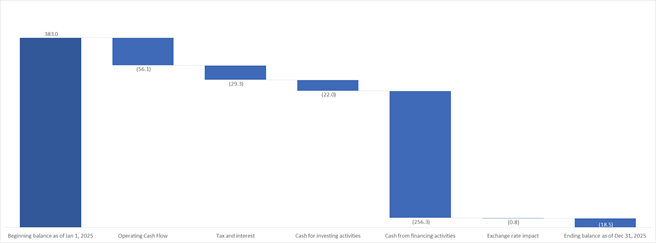
In 2025, the Company used net cash in operating activities amounting to 85.0 million Baht, which included payments for finance costs of 200.3 million Baht and income tax of 30.1 million Baht. Therefore, the Company recorded net cash used in operating activities of 85.4 million Baht. Key changes in operating activities included: 1) Loss before tax of 919.3 million Baht, 2) Share of loss from investments in joint ventures of 314.7 million Baht, and 3) Finance costs of 308.3 million Baht.
For investing activities, the Company used net cash of 22.4 million Baht. Key transactions included: 1) Cash received from the sale of investment properties and equipment of 161.9 million Baht, 2) Increase in restricted bank deposits of 105.5 million Baht, 3) Cash paid for advances on investments of 100.0 million Baht, and 4) Cash paid for short-term loans to related parties of 39.8 million Baht.
For financing activities, the Company used net cash of 256.3 million Baht. Key transactions included: 1) Cash paid for debenture repayment of 1,486.8 million Baht, 2) Cash received from debenture issuance of 1,117.3 million Baht, 3) Cash received from short-term loans from other parties of 1,032.4 million Baht, and 4) Cash paid for short-term loan repayment to other parties of 865.4 million Baht.
Consequently, the Company had cash and cash equivalents of 18.5 million Baht as of December 31, 2025.
Cash Flow Movement in 2025
Debt Securities with Financial Ratio Requirements
Debt Securities with Financial Ratio Requirements Issued?
Yes
Can the Company Maintain the Reported Financial Ratios?
Yes
Explanation
The Company has fully complied with the financial covenants as stipulated in the terms and conditions of all outstanding debentures. The Company's Interest-Bearing Debt to Equity Ratio stands at 1.54 times, which remains well below the maximum limit of 2.50 times specified in the terms and conditions. This reflects the Company's capability to effectively manage its capital structure and liquidity in accordance with the conditions agreed upon with the debentureholders.
Factors That May Affect Financial Condition
Factors or Incidents That May Materially Affect Financial Condition
1. Risk Management Policy and Plan
In 2026, the business environment continues to change rapidly and with increasing complexity. The Company recognizes the importance of good corporate governance coupled with systematic enterprise risk management to ensure operations achieve the defined vision, goals, and objectives. The Board of Directors places great emphasis on risk management and has assigned the Risk Management Committee, along with relevant executives, to clearly define the risk management framework, structure, and operational guidelines. This includes formulating risk management policies and integrating international standard frameworks (COSO Enterprise Risk Management Framework: COSO ERM) with the Stock Exchange of Thailand's sustainable development guidelines (Environmental, Social, and Governance: ESG) to serve as a framework for assessing risk issues and as practical guidelines for personnel at all levels within the organization.
The Company has tasked relevant departments, such as the Risk Management Unit, Internal Audit Unit, and Risk Owners, with developing tools, guidelines, and overseeing the risk management process to cover key organizational risks both present and future. These include risks from economic, capital market, and interest rate fluctuations, geopolitical uncertainties, technological changes and cybersecurity, regulatory and legal changes, as well as increasingly stringent environmental and social issues. Furthermore, there is continuous monitoring, assessment, review, and surveillance of emerging risks to limit the likelihood and impact of losses to an acceptable level (Risk Appetite), while simultaneously seeking new business opportunities arising from such changes. The Company will regularly report risk management results to the Board of Directors.
2. Risk in Business Operations Regarding Land Acquisition for Project Development
The Company's project development strategy is to acquire high-potential land for the Group's development projects. The selection criteria focus on prime central business district (CBD) locations, proximity to amenities, good environments, convenient transportation, and closeness to employment hubs, ensuring that the Company's customers experience the best living environment. However, land in these areas is limited, and prices are continuously rising.
Nevertheless, the Company has mitigated the risk of acquiring land for project development by leveraging an extensive network of land brokers, the Company's website, and the executives' robust personal networks. This strong network enables the Company to source and purchase well-located land at reasonable prices. The Company also reduces risk by emphasizing in-depth research and market surveys. This data and research are utilized in the analytical process to evaluate and mitigate risks associated with the Company's land purchases.
3. Project Development Risk (Fluctuations in Construction Costs and Material Prices)
Construction materials represent a major primary cost that fluctuates with raw material prices, as well as changing oil prices and minimum wage policies. These are key factors that directly impact project development costs, which in turn affect the Company's future operational performance and financial position. To mitigate this risk, the Company hires a single principal contractor for structural work using a Lump Sum Construction Contract, covering both labor and material costs. This allows the Company to effectively control construction costs. Additionally, the Company purchases certain construction materials directly from manufacturers and pre-agrees on material delivery prices to reduce the volatility of material costs that could directly affect the Company's construction budget.
In developing projects, the Company also hires external consultants who possess the specific knowledge, capabilities, and direct expertise required for each project. The selection criteria for these external consultants take into account their specialized expertise, workforce capacity, and recognized reputation. Modern technology and equipment are utilized to improve work quality and align construction costs with the Company's targets. The Company also develops operational systems and enhances efficiency in the construction process to optimize cost and delivery efficiency, thereby minimizing price volatility and material shortage issues.
4. Risk of Financial Performance Depending on the Continuity of Current Projects and Revenue Recognition Gaps
Discontinuity in launching new projects may cause volatility in the Company's operational performance and financial status. Currently, the Company has three completed projects that are in the process of ownership transfer: The River, The Lofts Silom, and Tait Sathorn Twelve, along with projects prepared for launch next year. This is reflected in the Backlog as of December 31, 2025, shown in the table below:
Project | Total Units | Project Value (THB mm) | Units Sold, Pending Sale & Transfer | Backlog Value (THB mm) | Expected Transfer Period | Construction Status (%) |
Tait Twelve | 231 | 4,358 | 5 | 228 | Expected to deliver and transfer all within 2026 | 100 |
The River (New Sales) | 8 | 938 | 7 | 848 | Expected to deliver and transfer all within 2026 | 100 |
Total | 239 | 5,296 | 13 | 1,085 |
As seen in the table above, the backlog value comes from projects recognizing profit shares from investments, which are gradually depleting. Therefore, the Company faces the risk of discontinuous revenue recognition and delayed development of new projects, which could impact operational performance and financial status. However, the Company has planned to mitigate this risk by investing in the development of hotels and mixed-use office buildings. This will generate recurring income, improve cash flow management, and allow for better alignment of construction timelines with sales periods.
5. Risk from Sales and Revenue Collection
The strategy of launching pre-sales for condominium projects before construction begins not only helps reduce marketing risks but also provides the Company with the flexibility to adapt its products to rapidly changing market conditions. It also allows the Company to utilize customer installment payments as working capital. However, pre-selling condominiums carries the risk of construction cost control; since selling prices are set before construction begins, there is a possibility that construction costs may rise after the project has already been sold. Therefore, the Company mitigates this risk by entering into Lump Sum Construction Contracts with contractors and purchasing certain materials directly from manufacturers. This ensures effective cost control and maintains gross profit margins against material price fluctuations. Furthermore, the Company launches sales in phases to adjust selling prices appropriately in response to such construction cost volatility.
Additionally, the Company mitigates revenue collection risks arising from customers booking units but failing to transfer ownership (transfer failure rate) by collecting down payments at a rate of 25.00% - 30.00% of the selling price (the industry average for down payment collection is below 25% of the selling price). At the end of 2023 - 2025, the Company's booking cancellation rates were as follows:
Project | 2023 | 2024 | 2025 |
Tait Twelve | 5.96% | 8.3% | 0% |
The Estelle Phrom Phong | 13.58% | 0% | 0% |
The Lofts Asoke | - | 0% | 0% |
The Lofts Silom | - | 0% | 0% |
Total | 11.17% | 2.7% | 0% |
Note: In 2025, ready-to-transfer condominium units that the Company could record as sales revenue were gradually depleted, resulting in a 0% booking cancellation rate.
For the year 2025, there was no booking cancellation rate because the majority of units had already been transferred. The remaining units awaiting transfer belong to customers who are not yet ready due to reasons such as not receiving the desired loan amount, failing to secure a loan, or waiting to sell for short-term profit. When the contract period expires and the transfer cannot be completed, the Company must reclaim those units to sell to more ready buyers. Meanwhile, revenue from sales, rentals, and services in 2025 amounted to 129.6 million baht, derived from the Group's older projects: Tait Twelve, The Lofts Asoke, The River condo and View Mall, and Riva Vibe Hotel.
The Company also maintains a systematic process for tracking and collecting down payments from customers. A Customer Relations department closely monitors customers and reports periodically to management, ensuring timely action if issues with customer billing and payments are anticipated. Furthermore, the Company allows buyers to pay booking fees, contract fees, and monthly installments via credit card, ensuring on-time revenue collection. The majority of the Company's customers have high purchasing power and typically do not require loans to purchase the Company's products (less than 20% of the Company's customers require mortgages to transfer ownership).
Because the Company is recognized as a leading property developer in the premium residential market, and its projects are well-accepted both domestically and internationally for delivering value that meets customer needs, the Company enjoys a large number of repeat customers. These customers recognize the value of the Company's projects for both residential living and investment purposes.
Currently, the Company focuses on customers in neighboring regions, including Thailand and ASEAN countries, to reduce sales risk and volatility. Expanding the customer base enables the Company to continuously initiate new project developments, a crucial process for mitigating risks related to competition and changing customer behaviors. The Company adapts its business strategies to suit ever-changing environmental and economic conditions and develops new project formats that align with customer needs. The Company also believes that expanding the domestic customer base will help mitigate risks arising from overseas economic fluctuations.
6. Risk from Relying Primarily on Condominium Sales Revenue
Currently, the Group focuses primarily on developing condominium residential projects. In 2023 and 2024, the Company generated real estate sales revenue of 14.90 million baht and 123.65 million baht, or 5.49% and 84.26% of total revenue, respectively. In 2025, the Group recorded a minor real estate sales revenue of 89.31 million baht. This is due to the Company shifting its investment strategy from self-funding to Joint Ventures. Consequently, revenue and profit/loss recognition in the financial statements has transitioned from real estate sales revenue to recognizing the share of profit/loss from joint venture investments. Recently, as the majority of revenue from these groups has been gradually transferred and projects closed, coupled with a high reliance on condominium sales, any shift in consumer behavior toward other types of housing—such as single-detached houses or townhomes—could impact the Company's revenue and performance.
However, prior to investing in any project development, the Company conducts detailed feasibility studies to set appropriate selling prices for the location and target demographic's income. This includes studying market conditions, consumer behavior and demand trends, and calculating return on investment under various scenarios. During development, the Company maintains a policy of continuously monitoring market conditions, the national economy, and other factors that may impact the condominium sector.
Furthermore, to reduce reliance on condominium sales revenue, the Company has a policy to expand its business scope into developing real estate for rent, which will generate Recurring Income. Examples include Serviced Residences (e.g., Somerset Riverside Bangkok, a long-term residential rental project), Hotels (e.g., Lyf Riverside Bangkok), and office and commercial spaces (e.g., OCC - One City Centre, a Grade-A office building project on Ploenchit Road, developed through a Joint Venture Agreement with Mitsubishi Estate Co., Ltd., a leading Japanese developer). This also includes plans to develop Ultra-Luxury Branded Residences in provinces highly sought after by foreigners, aiming to achieve faster revenue recognition than traditional condominium developments.
7. Risk from Changes in Laws and Government Regulations
The real estate development business faces risks from changes in laws, regulations, and guidelines of relevant government agencies. These include the Town Planning Act, Building Control Act, and ministerial regulations affecting building design, such as the Open Space Ratio (OSR) and Floor Area Ratio (FAR). It also involves Bangkok Metropolitan Administration ordinances, regulations of the Department of Lands and the Treasury Department, and environmental permit requirements (EIA), especially for high-rise and extra-large buildings. Nevertheless, the Company mitigates this risk by closely reviewing legal constraints and regulations of relevant agencies before commencing any project. Feasibility studies are conducted with thorough consideration of current laws and regulations, ensuring strict compliance across all projects.
Regarding the Bank of Thailand's macroprudential policy on mortgage lending (LTV measures) aimed at preventing systemic risk—effective for mortgage contracts signed from January 20, 2020, onwards—this may cause buyers to delay purchasing decisions as they require more time to accumulate higher down payments mandated by the loan-to-value ratios.
The impact of these measures falls on borrowers whose first contract value exceeds 10.00 million baht, second-contract borrowers who have serviced their first contract for less than 2 years or whose contract exceeds 10.00 million baht (requiring a 20.00% down payment), and third-contract borrowers (requiring a 30.00% down payment). However, it is the Company's standard operating procedure to collect down payments of 25.00% - 30.00% of the unit price prior to the ownership transfer date. Therefore, the Company is confident that these measures will not materially impact its operations.
8. Risk of Shortage of Qualified Personnel
The Company operates in the real estate development sector, which heavily relies on the knowledge, capabilities, and specialized expertise of its management team and personnel. Human resources are key drivers of organizational success. The Company, therefore, prioritizes personnel risk management, starting from recruitment and selection to acquire highly qualified individuals suited for the Company. This extends to continuous training and development to enhance the knowledge and skills necessary for each employee's role, boosting morale, providing fair and appropriate compensation and benefits, and continuously reviewing and improving operational processes and systems. The Company has also established a Succession Plan to prepare personnel at both the executive and supervisory levels, preventing and mitigating risks associated with the shortage of key personnel with specialized knowledge and skills, thereby ensuring continuous and efficient business operations.
9. Risk from Relying on Foreign Customers, Especially Chinese Buyers
In recent years, there has been a significant trend of Chinese and Hong Kong investors purchasing condominium units in Thailand due to attractive investment yields. Popular locations include areas along mass transit lines in Bangkok and its vicinity, and neighborhoods with large Chinese communities, such as Ratchadaphisek, or areas with highly convenient public transportation and traffic routes.
A relatively high proportion of the Company's condominium units have been sold to foreign customers in recent years. Consequently, the Company faces risks from relying on the demand and purchasing power of foreign buyers or investors. This is particularly concerning if foreign customers decide to delay investments or cancel sale and purchase agreements due to factors such as the prolonged Russia-Ukraine war, or tensions between the US-Israel and Iran. These tensions have the potential to escalate into a broader Middle Eastern conflict. Recently, Iran has ordered the closure of the Strait of Hormuz, which could lead to higher energy and commodity prices and future shortages, directly impacting the cost of goods and services. Furthermore, this new conflict will inevitably affect China, a major importer of Iranian oil. If energy shortages occur, it could slow down the Chinese economy, potentially impacting the Company's future revenue and operational performance.
10. Risk from High Competition in the Real Estate Industry
Real estate development remains highly competitive among market players, especially along high-traffic routes like mass transit lines. The Company continues to focus on residential projects along these routes but observes an increasing trend toward mixed-use developments, combining office buildings, hotels, residences, shopping malls, and retail spaces. This approach maximizes the value of continuously appreciating CBD land prices. Additionally, some developers have clearly shifted focus towards senior living projects, resulting in high competition for both Thai and foreign elderly demographics. Furthermore, many developers are initiating projects through foreign joint ventures, mergers and acquisitions (M&A). Alongside new projects, ready-to-move-in condominiums cater most effectively to genuine residential demand and are gaining increased attention. Meanwhile, competitors are deploying various sales strategies to incentivize customer purchasing decisions.
Demand from high-purchasing-power clients for urban luxury or Super Luxury condominiums remains continuous, as this demographic is less impacted by economic downturns. However, these customers are highly meticulous in their product selection, and more developers are entering this market segment. As an experienced and specialized developer in the Luxury and Super Luxury condominium markets, the Company acknowledges the risk of high competition. The Company carefully considers various development factors and prioritizes research and development to enhance competitiveness. This includes conducting detailed studies to understand target demographics, surveying market needs regarding location, design, materials, construction quality, and residential innovation. This ensures the Company's projects stand out from competitors and that the brand positioning perfectly aligns with the target audience.
11. Risk from Economic Slowdown
In 2025, domestic and global economic conditions remain continuously uncertain due to geopolitical factors, interest rate and exchange rate volatility, inflation, and high levels of household debt. This has led to a slowdown in consumer purchasing power and investment confidence, directly impacting the real estate and hospitality sectors. Demand for condominiums and housing in certain areas may decline, particularly among customers reliant on financial institution loans and foreign buyers—who constitute a high proportion of total customers and remain sensitive to global economic shifts, international financial regulations, travel and tourism policies, and rising living costs. These factors could slow down project sales and tourism revenue, leading to intensified price competition and a potential decrease in the Company's profit margins.
Furthermore, recurring income real estate businesses, such as residential, office, and commercial rentals, also face economic slowdown risks. This can manifest through tenants delaying business expansion, reducing rented space, or negotiating for lower rental rates. However, the current revenue proportion from these businesses is relatively low compared to the Company's total revenue, keeping the negative impact on overall performance limited. Nonetheless, the Company continues to monitor economic conditions and tenant behaviors closely.
To manage economic slowdown risks, the Company prioritizes product R&D, project design, and market positioning that align with the potential and purchasing power of each customer segment. This includes conducting deep, clear studies of target customer behaviors and needs, as well as exploring and expanding into new customer bases both domestically and internationally. This reduces reliance on specific groups and creates a competitive advantage.
Additionally, the Company has diversified its business into areas generating Recurring Income, such as residential rentals, hotels, office rentals, and Mixed-use projects, to spread revenue risk. The Company has also engaged in Joint Ventures with foreign investors, such as Tokyo Tatemono and Mitsubishi Estate (leading Japanese real estate firms), to strengthen capital, enhance competitiveness, and elevate project value through design, new technologies, and project management standards. These measures aim to mitigate the impacts of economic slowdowns, build a robust customer base, and sustain long-term profitability.
12. Risk from Natural Disasters
In operating its real estate development business, the Company recognizes the potential risks of natural disasters such as earthquakes, floods, storms, and fires. These could cause structural damage or negatively impact the confidence of customers and stakeholders, especially in Thailand, where small to moderate earthquakes can occur in certain areas. Following an earthquake incident in certain parts of the country on March 28, 2025, the Company took proactive measures to assess impacts and review safety protocols for all projects, both under construction and completed.
The Company dispatched teams of structural engineers and specialists to thoroughly inspect buildings across all projects. The inspections revealed no damage or signs affecting the main structural integrity of the buildings. The specialist teams compiled structural stability assessment reports and documented safety data for each project as reference. Moving forward, the Company has planned to review and upgrade design and construction standards to comply with earthquake-resistant structural requirements, and has conducted additional structural risk analyses to bolster preventive measures in high-risk areas.
Regarding disaster monitoring and response, the Company mandates continuous tracking of information from the Thai Meteorological Department, the Department of Mineral Resources, and other relevant government agencies. Emergency response plans are regularly updated, and simulated drills are conducted for personnel at all levels and project residents to ensure understanding and readiness during actual events.
Through meticulous attention to every process—from design and construction to inspection and emergency preparedness—the Company is confident that the buildings in its real estate projects are robust and capable of preventing or mitigating damage from natural disasters to an appropriate degree. The Company stands ready to continuously monitor environmental conditions and disaster trends to elevate measures in alignment with future situations, thereby ensuring sustainable confidence among all stakeholders.
13. Progress of Investment in Convertible Notes of Nautilus and Related Projects
The Company invested in convertible notes of Nautilus Data Technologies, Inc. (“Nautilus”) pursuant to the agreement dated 31 August 2022 and as approved by the Board of Directors, with the objective of diversifying its investment portfolio into high-potential technology infrastructure businesses for long-term growth.
Following the investment, the Company has continuously monitored the progress of Nautilus. However, the development of the project did not proceed in line with the business plan presented at the time of investment. As a result, the Company has recognized an impairment of such investment in its financial statements for the year 2024, in order to appropriately reflect the situation in accordance with applicable accounting standards.
In addition, the Company previously entered into a Memorandum of Understanding (MOU) with domestic partners, namely Nava Nakorn Public Company Limited and RATCH Group Public Company Limited, on 17 June 2022, to explore opportunities for developing projects related to Nautilus’ business in Thailand.
As of present, no further actions have been undertaken in relation to such projects, and there are no material obligations arising from the said MOU. The Company will continue to monitor the situation and assess appropriate courses of action to safeguard the interests of the Company and its shareholders.
14. Progress of Capital Increase in Subsidiary and Liquidity Management
The Company has invested through Kamala Bay Holding Co., Ltd., a subsidiary in which the Company holds 80% of the shares, with the remaining 20% held by a co-investor, under a Shareholders’ Agreement for the development of a real estate project.
Following the establishment and commencement of the project, the Company and its co-investor have continuously adjusted the capital structure and investment terms to align with the evolving circumstances of the project.
The key project under Kamala Bay Holding Co., Ltd. is a luxury villa development comprising 13 units, located at Kamala Beach, Phuket. The Company remains on track to launch the project within Q2 2026, in line with its business plan.
Currently, the Company is in the process of negotiating a Brand License agreement with a leading international hotel operator to enhance the project’s positioning and value, particularly in terms of marketing, customer experience, and differentiation within the luxury segment. Such agreement involves complex legal and commercial considerations, and is therefore being carefully reviewed and negotiated to ensure alignment with good corporate governance and the best interests of the Company and its shareholders.
In the meantime, the Company has provided financial support to the subsidiary as necessary to maintain project continuity, in accordance with the relevant contractual framework and mutual agreements with the co-investor. The parties have also aligned on appropriate approaches to managing investment contributions to support the project’s long-term development.
The above actions aim to:
Ensure continuity of the project
Enhance the project’s long-term potential and value
Maintain strategic partnership with the co-investor
The Company continues to closely monitor the progress of the project and the status of its investment, while maintaining prudent capital structure and liquidity management to ensure alignment with prevailing conditions and to safeguard the interests of the Company and its shareholders.
Projects or R&D Affecting Future Results
None